
This one is different.
The last blog covered the process.
This one is about what happens inside your head while you’re going through it. Especially if you’ve built your identity around being a leader.
The Failure You Can’t Brief Away
Divorce hits differently when you’ve spent your life performing at a high level. You’re used to leading, making decisions, solving problems under pressure, and being the one others rely on. You understand both leadership and followership. You operate in environments where accountability is clear and outcomes are measurable.
Then suddenly, the most fundamental piece of your life—your marriage—fails.
And there’s no way to spin that.
You can debrief a bad sortie. You can correct a mistake in the cockpit. Those systems are built for recovery. This is not.
This feels like a failure of leadership at the most personal level—and there’s no checklist to walk you through it.
The Alpha Problem
If you identify as a high performer—someone who takes ownership and prides themselves on execution—divorce challenges your identity in a way few things can.
You start asking questions that don’t have clean answers.
- How did I not see this coming?
- Why couldn’t I fix it?
- Where did I fail?
Whether those questions are fair or not, the internal narrative becomes simple and heavy:
“I failed at the one thing that mattered most.”
That weight doesn’t go away quickly. It sits with you, whether you acknowledge it or not.
You Will Go Through the Five Stages of Grief
You don’t skip this part.
You will move through denial, anger, bargaining, depression, and eventually acceptance. Not in order, not cleanly, and not on a predictable timeline. There will be days where you cycle through multiple stages in a matter of hours.
That’s not weakness. That’s the process.
What matters is not avoiding it—but recognizing it for what it is so it doesn’t control how you operate.
While all of this is happening, nothing else stops.
You’re still expected to show up, fly safely, make decisions, and lead. The standard doesn’t change because your life did. There is no pause button in this profession.
You are dealing with one of the most disruptive events of your life while operating in an environment that demands precision, discipline, and control.
That gap between internal chaos and external expectations is real—and it’s where a lot of people struggle.
The Quiet Judgment — A Real Moment
“I hope that either all of us, or none of us, are judged by the actions at our weakest moment—but rather by the strength we show if we’re ever given a second chance.” — Ted Lasso
This isn’t theoretical.
I remember sharing the cockpit with another pilot who knew what I was going through. Over the course of the trip, he repeatedly talked about how stable his marriage was. He made multiple comments about divorce, about divorced people, and about how things fall apart.
He probably thought it was just conversation.
It wasn’t.
Sitting there, it didn’t feel neutral. It felt like judgment—subtle, indirect, but unmistakable.
The reality is the pain of divorce is much deeper than most people understand, and that’s one of the reasons this is being written. If you’re going through it—or ever do—hopefully you take something from this.
Mentorship vs. Judgment
There’s a contradiction in aviation that doesn’t get talked about enough.
We pride ourselves on mentorship. We train, guide, and develop others. It’s part of the culture and part of the responsibility.
But sometimes that line gets crossed.
There are pilots who will pass judgment on you as if your divorce represents a failure in their version of standards or mentorship. As if your personal situation reflects something about the profession or what they believe it should represent.
What makes it more frustrating is that this often comes from people who don’t know you, have never flown with you, and have no understanding of your situation.
That’s not mentorship.
That’s projection.
The Culture No One Talks About
There is an unspoken belief in parts of aviation that stability equals competence and instability raises questions.
When something personal breaks, it can feel like your credibility is being quietly evaluated. Your leadership is questioned without being said out loud. Your reputation feels like it took a hit.
There’s also a level of embarrassment that comes with it. Not always rational—but very real.
No one says it directly.
But you feel it.
What Actually Matters
This is where Mach Mentality applies.
You cannot control other people’s opinions, their assumptions, or the narratives they build in their own heads. That is outside your control.
What you can control is how you show up.
Your conduct, your professionalism, and your consistency become your response.
You don’t counter judgment with explanations. You don’t defend yourself in conversations that don’t matter.
You respond with execution.
Over time, consistency speaks louder than anything you could say.
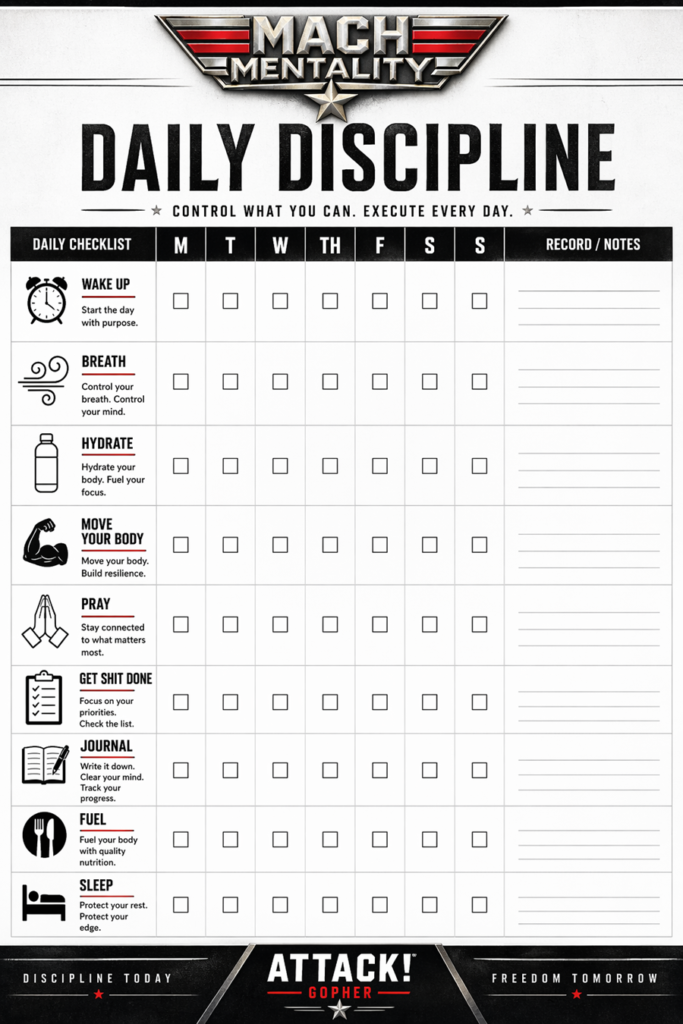
Daily Discipline — Your Control Panel
When everything feels unstable, you need structure.
Not motivation. Not emotion.
Discipline.
This is your daily reset:
- Wake up
- Breathe
- Hydrate
- Move your body
- Pray
- Focus on your tasks
- Journal
- Fuel properly
- Sleep
When everything else feels out of control, this becomes the structure that keeps you grounded.
Reframing the “Failure”
Divorce may represent the failure of a relationship. It does not automatically mean failure of leadership.
Sometimes the structure doesn’t hold. Sometimes timing doesn’t align. Sometimes the demands of the career amplify issues that would have otherwise stayed manageable.
Ownership still matters. But accuracy matters just as much.
Take responsibility for what is yours. Learn from it. But don’t carry weight that doesn’t belong to you.
Mach Mentality: The Internal Debrief
You will question yourself. You will feel like you failed. You may feel judged—even by people who don’t know you. And at the same time, you will still be expected to perform.
What matters is how you move forward. Not by ignoring what happened, but by processing it, learning from it, and continuing to operate at a high level.
Final Word
Leadership isn’t proven when everything is working.
It’s proven when things fall apart—and you still show up, stay steady, take responsibility, and move forward.
Divorce doesn’t disqualify you.
How you handle it defines you.
Perspective in this post was sharpened through conversations with Luke Kayyem — www.LukeKayyem.com
Attack!
Gopher